
A goal you choose
Start with something specific: an evening routine you want to change, a stress-linked habit, or a response you want to practice. The goal belongs to you.
When the intention is clear but the habit keeps returning, another conversation with yourself may help. Explore goal-focused hypnosis with Dr. Mahrukh Mustansar, psychologist, coach, and Certified Professional Hypnotist.
Ask about hypnotherapy
 Certified Professional HypnotistICBCH · Documented June 2024
Hypnosis is a process involving focused attention and responsiveness to suggestion. Guided imagery and carefully chosen language can be used to rehearse ways of responding to situations that matter to you. Experiences differ: there is no required feeling of being “under,” and dramatic sensations are not proof of progress.
Start with something specific: an evening routine you want to change, a stress-linked habit, or a response you want to practice. The goal belongs to you.
Discuss the approach and boundaries first. Ask questions, decline a suggestion, or request a pause. Hypnosis is not a truth test or a way to surrender your choices.
Agree on a practical experiment and review what actually happens. Insight matters most when it connects with the moments you want to handle differently.
Some reactions feel automatic: a familiar situation arrives, and the urge or response follows before you have considered another option. “Subconscious” is everyday shorthand for these learned associations and processes outside immediate awareness—not a hidden chamber a practitioner can unlock.
Hypnosis uses concentrated attention and personally relevant suggestions to explore a different response. You might imagine encountering a familiar cue, rehearse an alternative, and then practice it in daily life. This is a way of working with attention and expectation, not erasing a memory or permanently reprogramming the brain.
Conceptual illustration, not a brain scan or a measured mechanism.The pace and methods are agreed together.
Begin with a conversation about your goal.
Discuss your goal, relevant health context, expectations, and whether this approach is suitable.
If agreed, use attention, relaxation, or imagery to become absorbed in a chosen experience.
Explore suggestions linked to your goal—for example, imagining a pause and a different action when a cue appears.
Reorient, reflect on the experience, and choose a realistic practice to try between sessions.
The experiment might be putting the phone aside and taking a brief walk first. Progress could mean noticing the urge earlier, trying the alternative more often, or recovering sooner after a setback. This is an example of a goal, not a reported client result.
“Clinical hypnosis” describes hypnosis used within healthcare for a defined concern. Evidence is specific to the condition and protocol: findings in one area do not establish effectiveness for every habit or diagnosis. Research includes pain, gut-directed hypnosis for IBS, and some procedure-related anxiety.
Dr. Mahrukh’s service here combines professional hypnosis and coaching, informed by her documented ICBCH and NGH training. The work starts with your goals and a discussion of fit. Medical conditions require appropriately qualified care.
Read NCCIH’s evidence overview ↗An unwanted routine and a substance use disorder are not interchangeable. Hypnosis may be explored as an adjunct to appropriate support, but research does not justify promising that every addiction will end in a few sessions. Smoking-cessation studies have not established reliable superiority over other support.
If addiction is involved, discuss evidence-based treatment and medical needs first. This service does not provide detoxification, withdrawal management, or medication changes. Do not abruptly stop alcohol, sedatives, or prescribed medication without appropriate medical advice.
Read the smoking-cessation review ↗Tell the practitioner about relevant conditions and ongoing care. A history of psychosis or epilepsy warrants medical advice before considering hypnosis. A referral or a different form of support may be the appropriate next step.
NHS guidance on suitability ↗The certificates below name Dr. Mahrukh Mustansar and document her hypnosis qualifications. Open each to read the original credential.
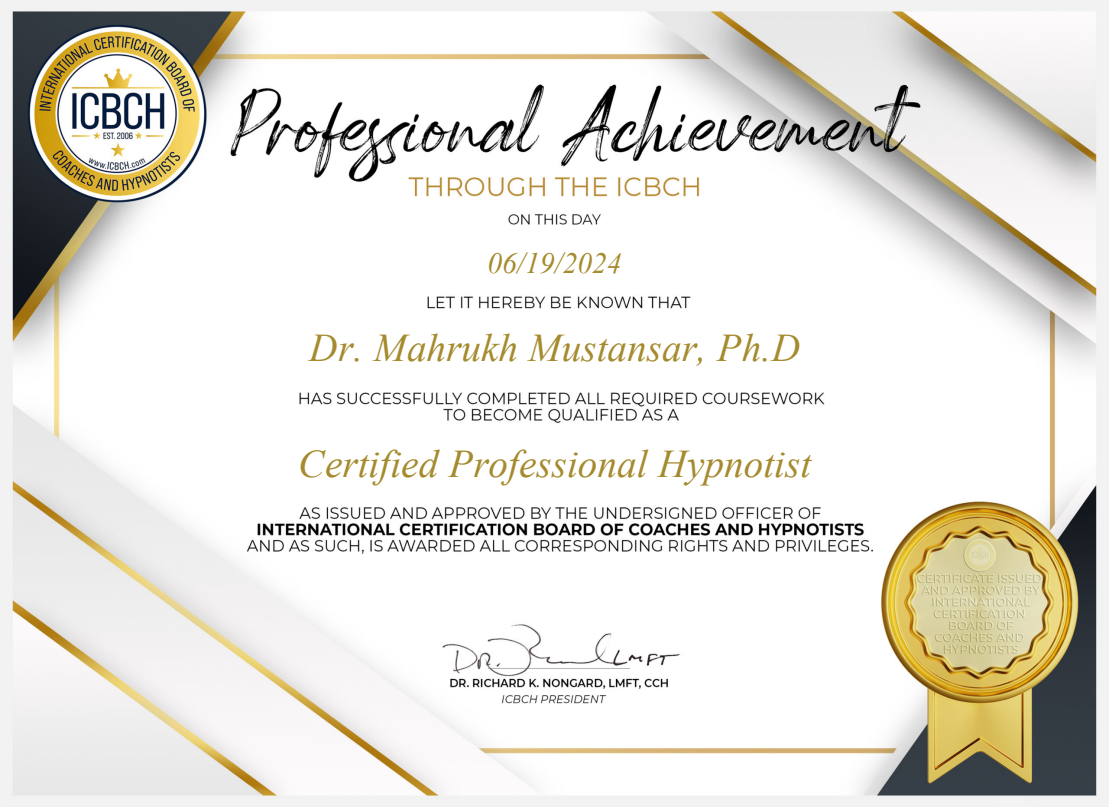
ICBCH · Coursework completion · June 19, 2024
The certificate records completion of the required coursework for this designation.
Read the certificate ↗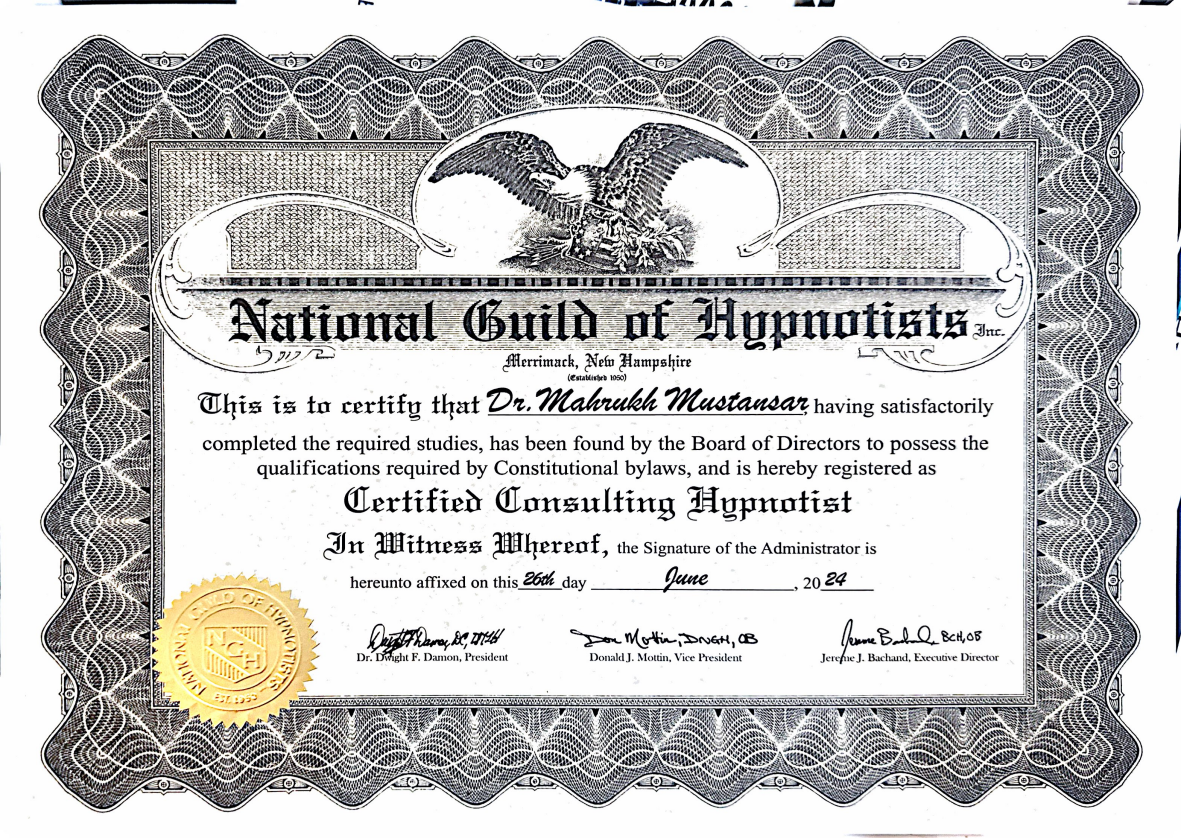
National Guild of Hypnotists · June 26, 2024
The certificate records completion of required studies and the NGH designation.
Read the certificate ↗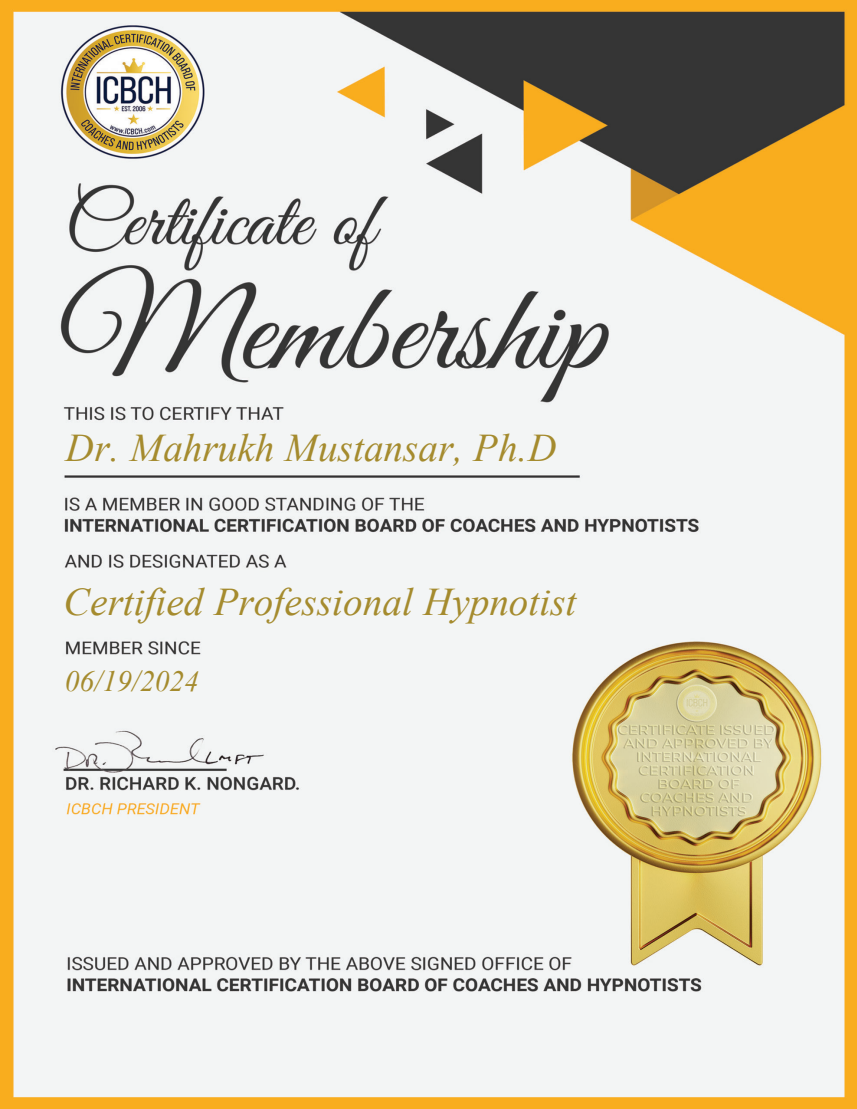
Member since June 19, 2024
The supplied document names the Certified Professional Hypnotist designation and records membership at issue.
Read the certificate ↗These are professional certification and membership documents, not government-issued licenses. The supplied documents do not establish an advanced clinical designation. The separate NGH membership document expired in July 2025; it is not used here as evidence of current membership. Current renewal status has not been independently confirmed with either organization.
For clients who want it, goals and imagery can be discussed in the context of their beliefs and values. Islamic reflection is an available specialty. Nothing spiritual is required, and no belief system is imposed.
Explore faith-based & spiritual psychology ↗No. This service uses conversation, focused attention, imagery, and suggestion. It does not involve psychedelics or drug administration. This is not a comparison with, or recommendation about, medically supervised treatments.
That depends on your goal, response, and circumstances. Agree on goals and review points early. There is no fixed session count that guarantees an outcome, and no requirement to commit to an ongoing package on the discovery call.
Her supplied credentials state Certified Professional Hypnotist (ICBCH) and Certified Consulting Hypnotist (NGH), awarded in June 2024. Open the documents above to read the designations and dates, along with the membership-status note.
Hypnosis is not a reliable method for establishing whether a memory is historically accurate. This service is presented around current goals and responses, not promises of recovering hidden truth.
Request a free 15-minute discovery call to discuss suitability and format. Sessions can be arranged in Reston or online where appropriate. Personal sessions are $250 for 45–60 minutes; scheduling and payment are arranged directly.
The explanations above distinguish the general study of hypnosis from this practitioner’s documented qualifications and service scope.
APA: evidence-based clinical hypnosis, including memory limitations ↗Take 15 minutes to share what’s on your mind, ask your questions, and explore whether coaching with Dr. Mahrukh feels right for you.
In person in Reston, Virginia · Online across the DMV
1920 Association Drive, Suite 509, Reston, VA 20191