You reply quickly because you care about your work. Over time, the quick reply becomes expected, and the expectation expands into evenings, weekends, and moments that were supposed to be yours. A boundary is harder to communicate after you are already angry. Start by distinguishing true urgency from habit and unclear expectations. Some roles genuinely include on-call responsibilities. A useful plan accounts for that rather than pretending every worker can simply turn a phone off at five.
Negotiate expectations in concrete terms
Write down the difference between routine requests, time-sensitive work, and emergencies in your role. Then ask the relevant person whether your understanding matches theirs. You may discover that you have been answering an expectation nobody actually stated. You may also discover a real workload problem that needs an organizational decision. Coaching can help prepare the conversation and clarify priorities, but it cannot create staffing, authority, or job security that you do not have.
A small experiment to try
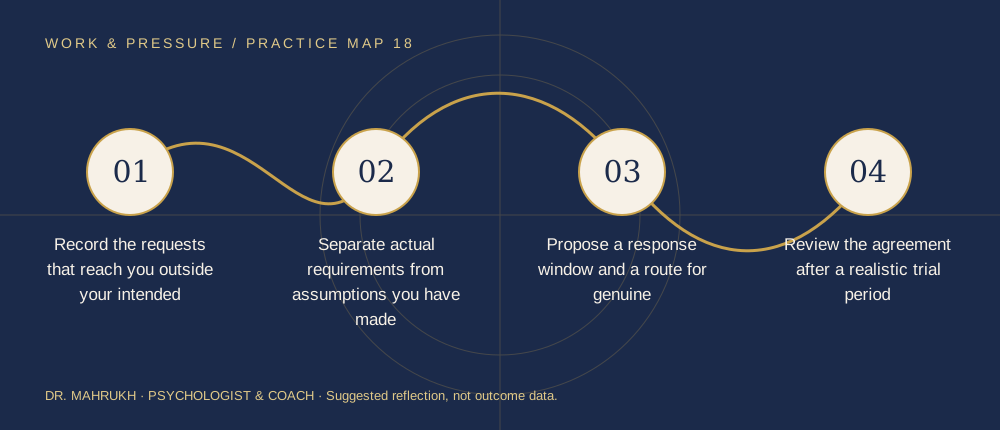
- Record the requests that reach you outside your intended hours.
- Separate actual requirements from assumptions you have made.
- Propose a response window and a route for genuine emergencies.
- Review the agreement after a realistic trial period.
Illustrative wording: “I can reliably respond to routine messages the next business morning. For the two issues that genuinely cannot wait, can we agree on a call rather than expecting continuous monitoring of every channel?”
What to notice
Look for clarity, consistent expectations, and the number of avoidable interruptions. Evaluate whether the arrangement works for your actual role rather than copying someone else’s boundary.
Which part of your availability has never been explicitly agreed?
You can reflect privately or bring this question to a conversation. Nothing you write needs to be entered on this website.
Where Dr. Mahrukh’s coaching can fit
Executive and personal coaching can help turn a broad concern such as balance into a concrete conversation about priorities, workload, boundaries, and relationships. It is also a place to distinguish what you can change personally from what requires a manager, organization, or structural solution.
Dr. Mahrukh is a psychologist and coach based in Reston, serving individuals, couples, families, and leaders across the DMV. A free 15-minute discovery call is a place to ask about fit, methods, and the next practical step.
This guide is educational. If symptoms are persistent, severe, or disrupting daily functioning, seek an appropriate health professional. A workplace problem is not automatically a failure of your mindset.
15 minutes · No obligation · In person in Reston or online
Sources & context
This article combines original educational examples with background reading. Illustrations describe possibilities, not actual clients or promised outcomes.
NIMH: Caring for Your Mental Health ↗Prepared with AI assistance for Mintlife Health editorial. Approved for publication on September 13, 2026. Educational information; not represented as personally authored or clinically reviewed by Dr. Mahrukh.