The laptop closes, but your attention stays in the meeting. A simple question at home feels like one demand too many. Later, you regret the sharp answer and wonder why the people you care about get the most depleted version of you. In the DMV, a long commute or a demanding remote-work schedule can make the boundary between work and home feel thin. You may not control every demand, but you can examine how you enter the next part of your day.
Build a transition people can understand
An original transition plan includes a signal, a short reset, and a reconnection point. The signal tells your household what is happening. The reset gives you a brief, defined space to shift attention. The reconnection point prevents that space becoming indefinite withdrawal. Negotiate this with the people affected rather than announcing that everyone must leave you alone. They may also need a transition. A useful agreement makes room for both needs and the practical realities of caregiving.
A small experiment to try
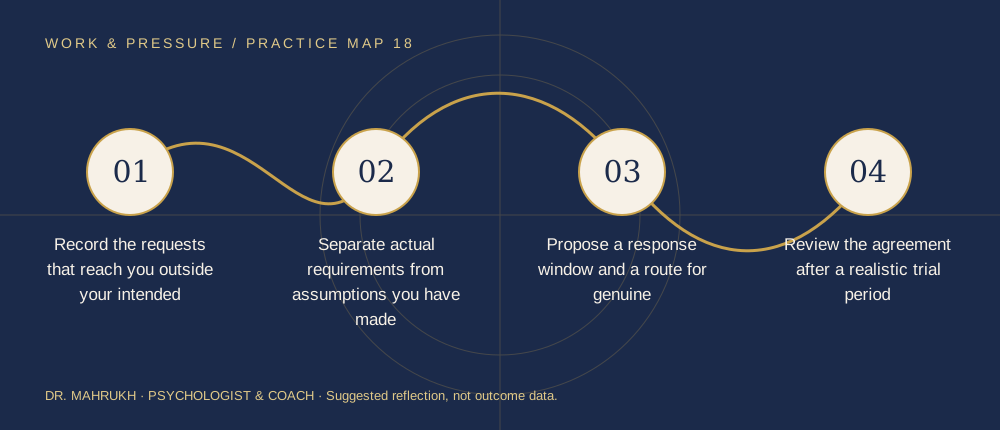
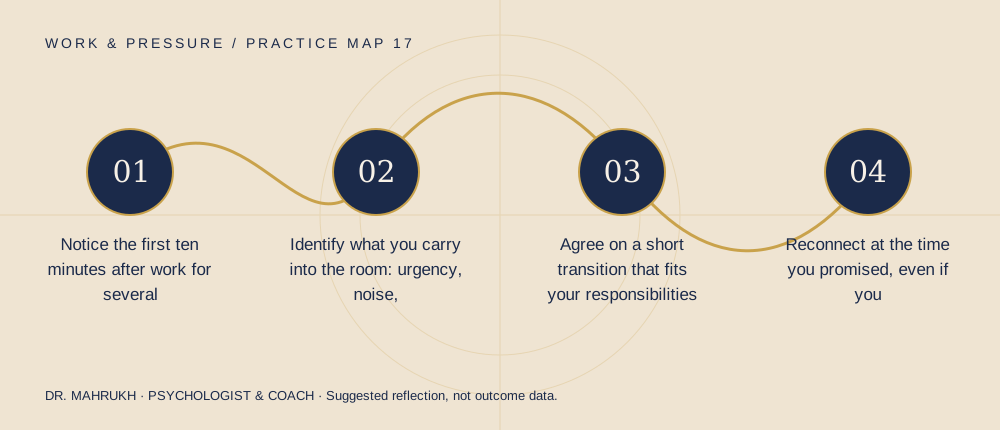
- Notice the first ten minutes after work for several days.
- Identify what you carry into the room: urgency, noise, hunger, or unfinished thinking.
- Agree on a short transition that fits your responsibilities.
- Reconnect at the time you promised, even if you need to explain that the day is still with you.
Illustrative wording: “I am glad to be home. I need ten minutes to change and put work away, then I want to hear about your day.” This offers a return, not just a retreat.
What to notice
Notice whether the transition happens and whether your first conversation becomes more intentional. Ask for feedback rather than assuming your household experiences the change as you do.
What would help you arrive at home mentally as well as physically?
You can reflect privately or bring this question to a conversation. Nothing you write needs to be entered on this website.
Where Dr. Mahrukh’s coaching can fit
Executive and personal coaching can help turn a broad concern such as balance into a concrete conversation about priorities, workload, boundaries, and relationships. It is also a place to distinguish what you can change personally from what requires a manager, organization, or structural solution.
Dr. Mahrukh is a psychologist and coach based in Reston, serving individuals, couples, families, and leaders across the DMV. A free 15-minute discovery call is a place to ask about fit, methods, and the next practical step.
This guide is educational. If symptoms are persistent, severe, or disrupting daily functioning, seek an appropriate health professional. A workplace problem is not automatically a failure of your mindset.
15 minutes · No obligation · In person in Reston or online
Sources & context
This article combines original educational examples with background reading. Illustrations describe possibilities, not actual clients or promised outcomes.
NIMH: Caring for Your Mental Health ↗Prepared with AI assistance for Mintlife Health editorial. Approved for publication on September 13, 2026. Educational information; not represented as personally authored or clinically reviewed by Dr. Mahrukh.