It is easy to name values in the abstract: compassion, honesty, faith, connection, service. It is harder to recognize them in a rushed weekday full of competing demands. A values conversation becomes more useful when it reaches the level of a specific action. That action does not have to be impressive or visible to others. It needs to express something you genuinely care about. Otherwise, values can become another list of ideals you feel you are failing to live up to.
Choose an expression that fits your life
An original values-to-action exercise asks you to complete this sentence: “If this value were visible in my next week, someone might notice…” You might listen without interrupting, tell the truth about your capacity, or protect a personally meaningful reflective practice. Avoid treating a single action as proof of your entire character. A value can guide a choice without becoming a score. If two values conflict, name both rather than pretending the decision is simple.
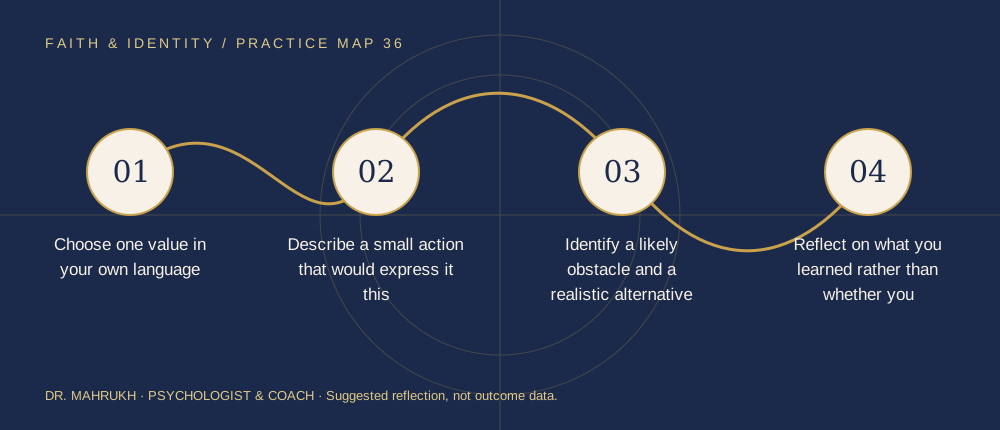
A small experiment to try
- Choose one value in your own language.
- Describe a small action that would express it this week.
- Identify a likely obstacle and a realistic alternative.
- Reflect on what you learned rather than whether you performed the value perfectly.
Illustrative example: A person values generosity but is overcommitted. They choose one contribution they can offer reliably and communicate a clear limit on additional requests, honoring both care and honesty.
What to notice
Notice whether the action felt connected to the value and whether it was sustainable. More effort is not always a more faithful expression of what matters.
What would one of your values look like in a small, observable choice?
You can reflect privately or bring this question to a conversation. Nothing you write needs to be entered on this website.
Where Dr. Mahrukh’s coaching can fit
Faith-based guidance and spiritual psychology are available within Dr. Mahrukh’s coaching when the client wants them included. The conversation can hold values, family expectations, and personal experiences together without assuming every Muslim or every household has the same needs.
Dr. Mahrukh is a psychologist and coach based in Reston, serving individuals, couples, families, and leaders across the DMV. A free 15-minute discovery call is a place to ask about fit, methods, and the next practical step.
Spiritual reflection is optional. It should not be used to excuse mistreatment, blame someone for distress, or discourage appropriate health care. This guide is not a religious ruling.
15 minutes · No obligation · In person in Reston or online
Sources & context
This article combines original educational examples with background reading. Illustrations describe possibilities, not actual clients or promised outcomes.
Yaqeen Institute: Mental Health & Wellness ↗Prepared with AI assistance for Mintlife Health editorial. Approved for publication on September 13, 2026. Educational information; not represented as personally authored or clinically reviewed by Dr. Mahrukh.