A parent sees a tradition as a source of belonging. A young person experiences the same expectation as a test they cannot pass. Neither meaning is captured by simply calling someone too Western or too traditional. Families navigating more than one cultural context may need a vocabulary that makes room for both continuity and change. Begin with the specific expectation at issue rather than debating which entire culture is superior. The conversation becomes more useful when everyone can explain what they are protecting.
Separate a value from its familiar expression
An original family exercise asks each person to complete two sentences: “The value I want to preserve is…” and “The way I have learned to express it is…” Respect, for example, may be expressed through silence in one context and an honest discussion in another. Naming that difference does not force agreement. It lets you consider whether the same value can have more than one acceptable expression. Faith can be included when the family wants it, without treating a cultural habit as an unquestionable religious requirement.
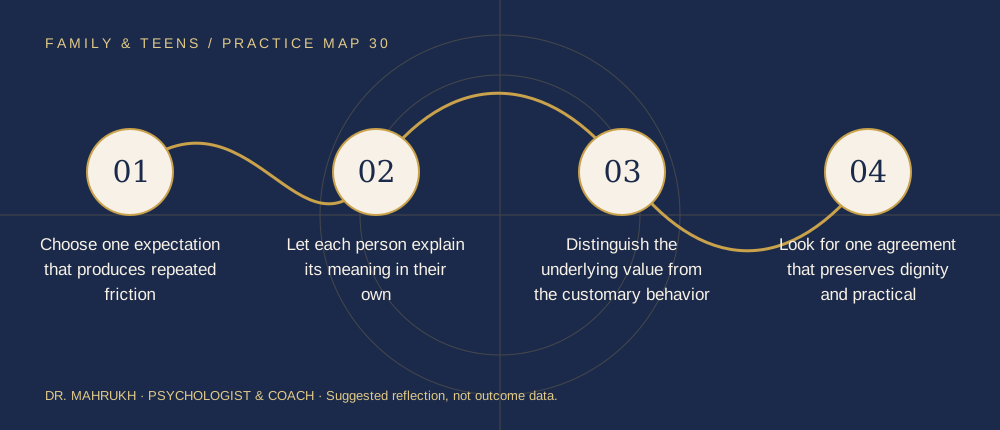
A small experiment to try
- Choose one expectation that produces repeated friction.
- Let each person explain its meaning in their own words.
- Distinguish the underlying value from the customary behavior.
- Look for one agreement that preserves dignity and practical boundaries.
Illustrative question: “When you say this feels disrespectful, what part feels that way to you? When I ask questions, I am trying to understand the decision, not reject our family.”
What to notice
Observe whether family members can describe one another’s perspective more accurately, even when a disagreement remains.
Which shared value is getting hidden by different ways of expressing it?
You can reflect privately or bring this question to a conversation. Nothing you write needs to be entered on this website.
Where Dr. Mahrukh’s coaching can fit
Family coaching can help parents and young people describe what each person needs, agree on a manageable experiment, and review it without turning every conversation into a verdict. The young person’s perspective matters alongside the parent’s responsibilities.
Dr. Mahrukh is a psychologist and coach based in Reston, serving individuals, couples, families, and leaders across the DMV. A free 15-minute discovery call is a place to ask about fit, methods, and the next practical step.
This is general parenting education, not a diagnosis. Significant changes in safety, functioning, eating, sleep, or mood deserve appropriate professional assessment. Ask about participation and confidentiality before arranging support for a minor.
15 minutes · No obligation · In person in Reston or online
Sources & context
This article combines original educational examples with background reading. Illustrations describe possibilities, not actual clients or promised outcomes.
Yaqeen Institute: Mental Health & Wellness ↗Prepared with AI assistance for Mintlife Health editorial. Approved for publication on September 13, 2026. Educational information; not represented as personally authored or clinically reviewed by Dr. Mahrukh.