You can imagine the ideal version so clearly that a smaller attempt feels embarrassing. If you cannot complete the full routine, you skip it. If the first draft is awkward, you avoid opening it. Perfectionism can make an ordinary task feel like a public test of who you are. Coaching can explore how that standard operates and what it costs you. The immediate goal need not be becoming relaxed about everything. It can be learning where a good-enough version serves your values better than no version.
Define adequacy before the task becomes emotional
Choose a low-stakes activity and write three levels: minimum acceptable, useful improvement, and unnecessary polish. The categories are your experiment, not universal rules. A safety-critical task needs different standards from a personal journal entry. Naming that distinction matters. Ask what the task is for and whose judgment you are anticipating. If the expected criticism is mostly your own, consider what information would help you decide the work is ready rather than revising indefinitely.
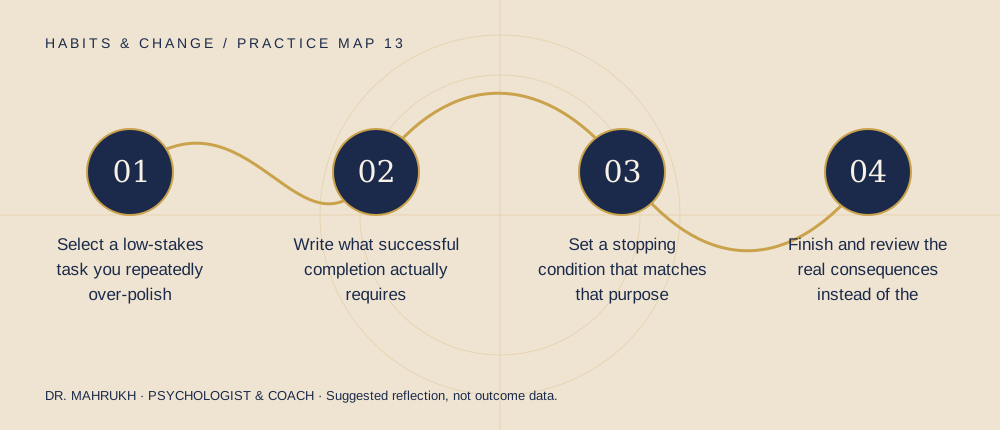
A small experiment to try
- Select a low-stakes task you repeatedly over-polish.
- Write what successful completion actually requires.
- Set a stopping condition that matches that purpose.
- Finish and review the real consequences instead of the feared ones alone.
Illustrative example: A routine meeting update needs three accurate points and a clear request. It does not need an elegant narrative, custom graphics, and twelve rounds of rewriting.
What to notice
Notice completion, time spent polishing, and whether the feared consequence actually occurred. Keep the experiment proportionate to the task.
Where is your standard protecting quality, and where is it preventing participation?
You can reflect privately or bring this question to a conversation. Nothing you write needs to be entered on this website.
Where Dr. Mahrukh’s coaching can fit
A coaching conversation can explore the situation around a habit: what comes before it, what it provides in the moment, and what would make another response easier. The aim is a realistic plan you can evaluate, rather than a promise of permanent change after a fixed number of sessions.
Dr. Mahrukh is a psychologist and coach based in Reston, serving individuals, couples, families, and leaders across the DMV. A free 15-minute discovery call is a place to ask about fit, methods, and the next practical step.
Persistent distress or substance dependence can require medical care. Coaching can complement appropriate care; it does not replace assessment, medication, or medically supervised withdrawal.
15 minutes · No obligation · In person in Reston or online
Sources & context
This article combines original educational examples with background reading. Illustrations describe possibilities, not actual clients or promised outcomes.
NIH: Creating Healthy Habits ↗Prepared with AI assistance for Mintlife Health editorial. Approved for publication on September 13, 2026. Educational information; not represented as personally authored or clinically reviewed by Dr. Mahrukh.