The task sits on your list while you complete everything around it. You rearrange your desk, answer easier messages, and promise to start after one more small job. Procrastination can have many contributors, including uncertainty, fear of judgment, exhaustion, and an unrealistic workload. A motivational slogan will not tell you which one is present. Start by naming what you are avoiding with enough precision that you can design a useful experiment. “Work on the presentation” may be too vague to begin.
Replace a project with a visible first action
An original starting exercise asks for an action you could demonstrate to another person: create a blank document, write three questions the presentation must answer, or find the missing number. Give yourself a short time window and permission to produce an unfinished result. This does not mean lowering every professional standard. It separates beginning from polishing. If you repeatedly cannot begin even very small tasks, or attention difficulties affect several parts of life, a broader assessment may be more useful than another productivity system.
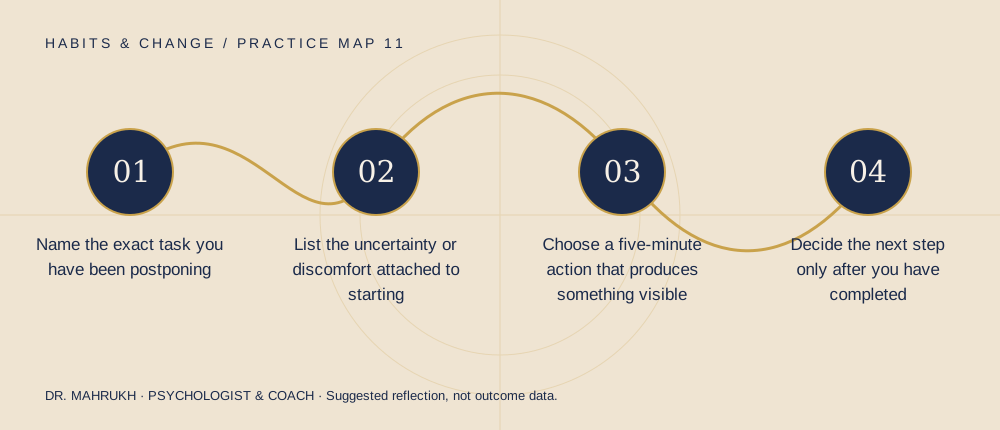
A small experiment to try
- Name the exact task you have been postponing.
- List the uncertainty or discomfort attached to starting.
- Choose a five-minute action that produces something visible.
- Decide the next step only after you have completed that action.
Illustrative example: Instead of “finish the proposal,” write the headings, add the client’s three requirements, and mark the information you still need. That imperfect outline becomes material you can improve.
What to notice
Observe how long it takes to begin and what helps you return after interruption. Avoid using output alone to judge effort.
What is the smallest action that would make this task less undefined?
You can reflect privately or bring this question to a conversation. Nothing you write needs to be entered on this website.
Where Dr. Mahrukh’s coaching can fit
A coaching conversation can explore the situation around a habit: what comes before it, what it provides in the moment, and what would make another response easier. The aim is a realistic plan you can evaluate, rather than a promise of permanent change after a fixed number of sessions.
Dr. Mahrukh is a psychologist and coach based in Reston, serving individuals, couples, families, and leaders across the DMV. A free 15-minute discovery call is a place to ask about fit, methods, and the next practical step.
Persistent distress or substance dependence can require medical care. Coaching can complement appropriate care; it does not replace assessment, medication, or medically supervised withdrawal.
15 minutes · No obligation · In person in Reston or online
Sources & context
This article combines original educational examples with background reading. Illustrations describe possibilities, not actual clients or promised outcomes.
NIH: Creating Healthy Habits ↗Prepared with AI assistance for Mintlife Health editorial. Approved for publication on September 13, 2026. Educational information; not represented as personally authored or clinically reviewed by Dr. Mahrukh.